
AMH level chart by age
- 27 Jan, 2026
- IVF and Infertility
- infertility
- Medically Reviewed By:
 Dr. Nishi Singh
 - Author: Prime IVF Centre
#Medically reviewed by Dr. Nishi Singh, IVF Specialist – Prime IVF
Anti-Mullerian Hormone (AMH) is among the best indicators of the strength of ovarian reserve of a woman, which is the count of eggs that she has in her ovaries. AMH levels assist fertility specialists in assessing the potential to be fertile and then plan to treat. These levels change in individuals across age, and they offer valuable information about one’s reproductive health. Granting frequent AMH tests can detect a diminished ovarian reserve in advance, and women can make informed choices about their families accordingly. At Prime IVF Centre in Delhi NCR, the AMH test is done in the context of a detailed fertility test and diagnosis to design personalized treatment plans that can enhance pregnancy and help women to create their parenthood steps with accuracy and caution.
Table of Contents
- Understanding AMH and Its Role in Fertility
- AMH Level Chart by Age
- What Low or High AMH Levels Indicate?
- How AMH Testing Helps Create Personalized Fertility Treatment?
- Conclusion
Understanding AMH and Its Role in Fertility
The granulosa cells are the ones that encircle immature eggs in the ovaries to produce AMH. The quantity of AMH in the blood shows the number of eggs in reserve, also referred to as ovarian reserve. It is also unlike other fertility hormones that AMH levels do not vary much during the menstrual cycle; therefore, it is a consistent measure regardless of the time of the month.
This hormone is very important in directing fertility interventions such as IVF, IUI, or egg freezing. Values above the AMH show that more eggs are available whereas low values indicate low ovarian reserve and low fertility potential.
In women experiencing challenges with the conception process, the AMH test is a method that can be used to guide fertility specialists on how to formulate the right treatment strategies, calculate the ovarian stimulation dosage, and make predictions about the anticipated reactivity to the fertility drugs. AMH testing is usually performedalong with the other hormonal tests (such as FSH, LH, and estradiol) so that the results can be interpreted correctly and tailored fertility treatment is provided to every patient, with the highest probability of success.
AMH Level Chart by Age
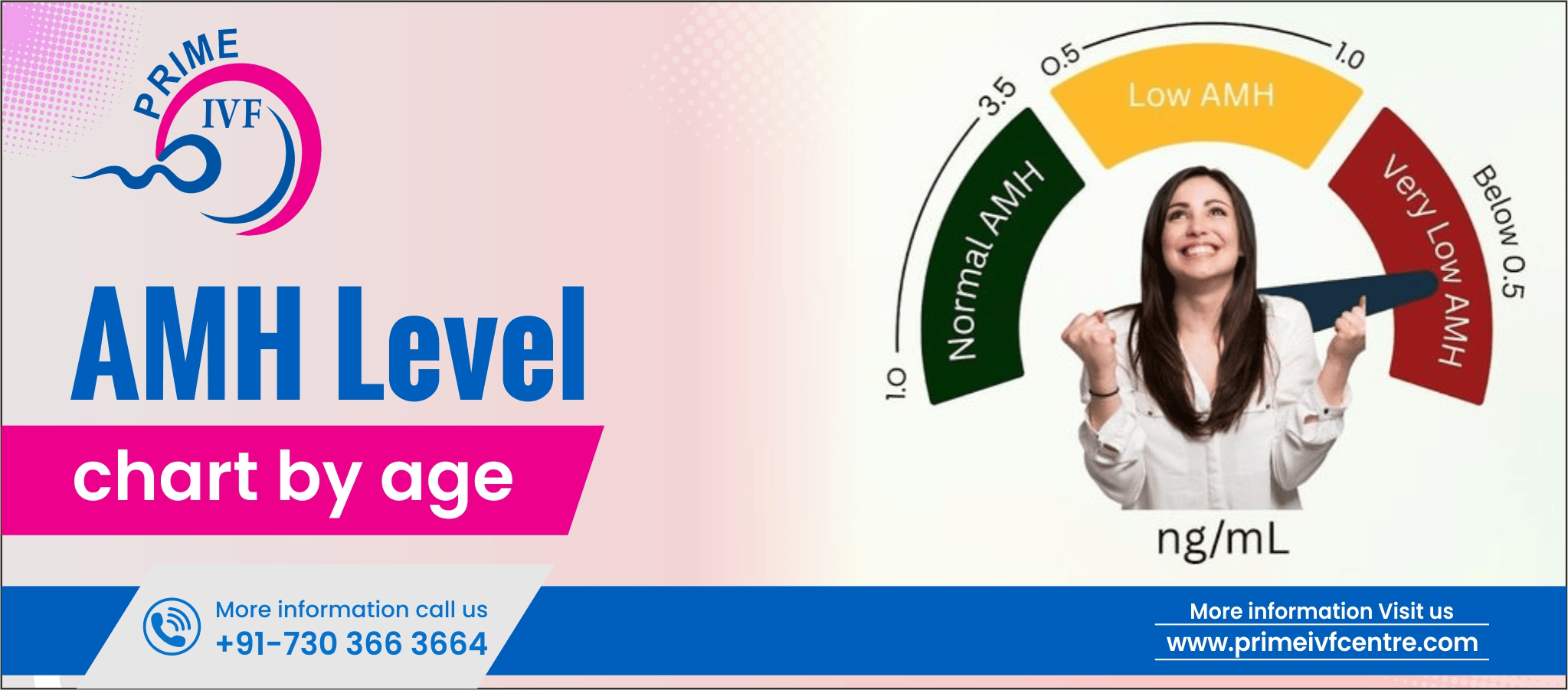
The AMH levels decline with age as women are born with a certain number of eggs. Understanding these levels helps in forecasting fertility potential and determining the timing of considering assisted reproductive methods.
Below is a general AMH chart by age to give an overview of typical ranges and what they mean.
AMH Levels in the 20s
Females of the 20s tend to possess a good AMH level of 3.0-4.5 ng/mL, which means that they have a great ovarian reserve and a very good potential of getting pregnant. The eggs are also of the best quality during this age, and conception is not difficult. Periodic AMH testing could assist women wishing to postpone pregnancy to realize their fertility potential and consider alternatives such as egg freezing in case of need.
AMH Levels in the 30s
At age 30 or below, the levels of AMH often reduce to 1.5-3.0 ng/mL. Gradually, the fertility starts decreasing, yet a great number of women still give birth naturally. The results of the testing at this period are useful in pregnancy planning or fertility preservation. With slightly lower AMH levels, they might consider an assisted reproduction technique.
AMH Levels in the Late 30s to Early 40s
The level of AMH usually drops to 0.5-1.5 ng/mL. This reduction is an indication of a reduced number of viable eggs and the possibilities of conception naturally begin to reduce. Nonetheless, even at this stage, fertility treatments, such as IVF, can be used to bring about pregnancy. Fertility specialists usually advise early diagnosis and early intervention to achieve positive results.
AMH Levels in the 40s and Beyond
The AMH levels tend to decline to below 1.0 ng/mL after 40, which indicates a major decrease in the quality and quantity of eggs. The probability of natural conception decreases, and such options as self or donor eggs IVF are generally considered. At this point, individualized treatment planning is imminent, and we at Prime IVFapply the modern reproductive technologies to enable women over 40 years to conceive successfully despite their dwindling ovarian reserves.
Also Explore: Can IVF Be Successful With Low AMH
AMH level by age samajhna fertility planning ke liye zaroori hai. Consult expert.
Consult a Fertility SpecialistWhat Low or High AMH Levels Indicate?
Here is a difference between low and high AMH levels and what they indicate.
-
Low AMH:
A low AMH level could signal reduced ovarian reserve, which could cause problems with natural conception. But still, it does not imply that it cannot get pregnant. Even low AMH women can have healthy eggs that can be fertilized successfully through fertility procedures such as IVF. (Explore: how to increase amh levels)
-
High AMH:
A High AMH level usually indicates a higher egg count but it may be an indication of Polycystic Ovary Syndrome (PCOS). Irregular periods as well as hormonal imbalance could affect ovulation in women with PCOS. Close attention and individual therapy allow for normalized hormone rates and enhance reproductive health.
How AMH Testing Helps Create Personalized Fertility Treatment?
The AMH testing will give the necessary information on how to create the most effective fertility treatment plan. It assists in establishing the most appropriate dose of medication to be used in the stimulation of the ovaries during IVF, approximates the quantity of eggs that can be collected, and assesses the responsiveness of the ovaries to the medication.
In women who have low AMH, reproductive endocrinologists suggest more high-tech methods of female reproductive therapy, including IVF with individual stimulation or oocyte donations. In women with high AMH, the treatment might be aimed at excessive stimulation prevention and hormone level normalization.
At Prime IVF, our fertility specialists use AMH testing as part of a comprehensive evaluation to personalize treatment strategies, improving both safety and success rates for every woman.
Also Read: AMH Test in Hindi
Conclusion
The AMH is an important tool to comprehend fertility and make an informed decision about your reproductive life. Knowing the age-related changes in AMH levels, women can make the right decision at the right time about conception or treatment. With accurate diagnosis of AMH levels and expert fertility care at Prime IVF, your path to parenthood becomes clearer and more achievable.
#This information is medically reviewed by fertility experts at Prime IVF Centre, serving patients across Delhi and Gurgaon.