Can AMH Be Increased Naturally? Diet, Supplements & Fertility Tips
- 27 Jan, 2026
- IVF and Infertility
- infertility
- Medically Reviewed By:
 Dr. Nishi Singh
 - Author: Prime IVF Centre
#Medically reviewed by Dr. Nishi Singh, IVF Specialist – Prime IVF
The most important indicator of ovarian reserve and fertility potential of a woman is anti-Mullerian hormone (AMH). When a woman is undergoing things where the AMH level is low, then pregnancy can be a difficult thing to achieve, yet the question arises whether there is any means by which you can increase your AMH level so that it can increase your chances of getting pregnant.
Table of Contents
- Interconnection between AMH and fertility
- Natural Ways to Support and Potentially Increase AMH Levels
- Conclusion
The answer is yes: AMH levels can be raised with some definite lifestyle modifications, dietary upgrades, and supplements, since this joint work will help to enhance your egg quality and ovarian activity. In this case, you will learn natural methods to implement in your new day-to-day life to improve AMH levels and facilitate a healthy reproductive system. If you are facing problems in natural conception or repeated failure of an IVF cycle, you need to check your AMH level. For a trusted examination and potential outcome, you need to visit Prime IVF Centre in Delhi NCR.
Interconnection between AMH and fertility
You now know that it is anti-mullerian hormones that dictate your ovarian reserve and fertility potential. Let's understand its mechanism. AMH is mainly produced in your ovaries. Testing your hormone levels provides information about ovarian reserve, which means how many eggs you have. In your ovarian follicles, there are granulosa cells that produce AMH hormone. If you have a low AMH level, it determines the diminished ovarian reserve or low egg count, and that is why the hormone is highly connected to your fertility level.
However, AMH levels do not predict the time of conception or infertility. But while treating infertility conditions, doctors usually use these AMH levels to understand if the ovarian reserve is diminishing rapidly than naturally, or if you have a limited number of eggs left. AMH levels are the best bet for predicting the progression of ovarian stimulation when they are used in IVF treatment. For a better understanding of the level of AMH in your body, its effects, and other derivatives, consult our gynecologists at Prime IVF Centre. We run tests to examine your AMH level, pride ourselves on adequate steps to increase it, and will explain its role in your fertility.
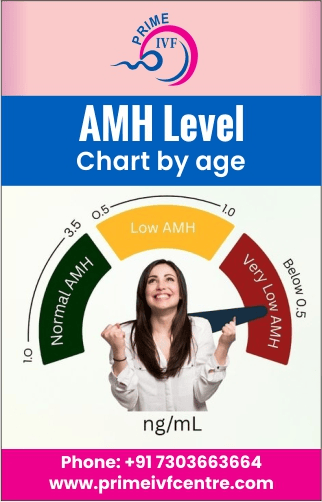
The following lower limit of the AMH level is presented according to age:
-
0.5 ng/ml- 45 years
-
1 ng ng/ml- 40 years
-
1.5 ng/ml- 35 years
-
2.5 ng/ml- 30 years
-
3.0 ng/ml- 25 years
Low AMH ko lekar worried hain? Know realistic options with expert guidance.
Consult a Fertility SpecialistNatural Ways to Support and Potentially Increase AMH Levels
With notable lifestyle changes, you can naturally increase your AMH level, leading to the number of developmental requirements for a positive pregnancy. Several authentic and organic strategies have proven effective in improving the environment, supporting follicle health, and producing measurable improvements in AMH levels. To develop a personalized plan, consult our gynecologists, obstetricians, and fertility specialists at the Prime IVF Centre to create a diet plan and improve your AMH level.
Taking adequate DHEA supplements
Various research studies have claimed that dehydroepiandrosterone or DHEA (adrenal androgen) improves ovarian responsiveness, especially for those who are suffering from rapidly diminishing ovarian reserve. In small trials, noticeable follicular development and improved embryo quality are observed, likely due to elevated AMH levels. The retrievable eggs are also enhanced when low-dose DHEA is given for various weeks before undergoing IVF. A cautionary measure: DHEA supplementation should be initiated after endocrine evaluation and administered under a fertility specialist's supervision. This is because it may be due to side effects or hormonal imbalance caused by incorrect dosages.
Maintaining coenzyme Q10 (CoQ10) balance
Coenzyme Q10 is an antioxidant that is involved in the generation of cellular energy, and a number of studies have shown how Coenzyme Q10 improves the functioning of the mitochondria in oocytes (eggs), improving their quality, especially among older women. There is some clinical research evidence of Coenzyme Q10 improvement of ovarian response and embryo quality following several months of Coenzyme Q10 supplementation. Experts in fertility have indicated that a regular intake of Coenzyme Q10 helps in the development of the ovarian functions and could enhance the AMH figures. Coenzyme Q10 supplementation is also beneficial for maintaining the reproductive enzymes in the cells against undue oxidative stress and makes it a prominent nutrient in general fertility, well-being, and a good outcome to pregnancy.
Consuming folic acid supplements
Vitamin B or folic acid is one of the essential factors in cell division, DNA proliferation, and the proper development of eggs. It helps in the good formation of the chromosomes and their functioning, reducing the chances of the development of neural tube defects witnessed during pregnancy. It is also very important in the preservation of hormonal balance and reproductive health, therefore, enhancing AMH. To this, you will need to consume foods that are high in folate, like leafy greens, whole grains, citrus foods, and lentils, regularly in order to improve the quality of eggs and the general fertility performance. Most fertility experts have suggested that the best dosage is approximately 400 to 800 MCG a day prior to conception to make sure that one has optimum reproductive health by the time of having a healthy pregnancy.
Engaging in continuous regular physical activity
A regular diet is absolutely mandatory, and you can see positive results. However, concurrently, when you do this daily exercise that involves physical activities, you have a high probability of increasing AMH levels. Frequent exercises improve blood circulation, hormonal balance, and healthy body weight, which are quite essential in fertility. It should be done by moderate exercises such as walking, yoga, swimming, or cycling that increase insulin sensitivity and decrease oxidative stress to stimulate the functionality of the ovary. Besides these parameters, exercises also guarantee a certain level of anxiety control and an increased level of energy, which is useful in the hormonal balance and is advantageous to the AMH levels. In this instance, though, you are supposed to consider that there are also side effects of extreme or intense exercises, such as ovulation and menstrual cycle interference. Therefore, this means that you exercise moderately and maintain a healthy diet to improve your reproductive system and become more fertile.
Avoiding processed foods
You need not take processed foods at all, in case your report shows that the AMH level is too low, and it is one of the greatest causes of infertility. This junk food is rich in trans fats, refined sugar, and preservatives, which are incredibly toxic to your metabolism, resulting in hormonal imbalance, which results in inflammation. Their mere restriction or even shunning is good in its encouragement of health. Bisphenol A is quite common in a variety of processed food items, including canned goods and packaged products, and it has a pernicious effect on the hormonal background and ovarian reserve. Less of it by not heating food in plastic containers with glass or stainless steel, and consuming the fresh vegetables, meat, or other foodstuffs rather than tinned foodstuffs. Imagine you eliminate packaging brought about by BPA chemicals and switch to a whole food diet. In that regard, it enhances levels of reproductive hormones, helps in the maintenance of eggs, and facilitates natural fertility restoration among women who have low levels of AMH.
Administering vitamin D and omega-3 fatty acids levels
Other vitamins and minerals also make significant contributions to hormonal balance and ovarian health. For example, if you are suffering from vitamin D deficiency, it is highly associated with poor egg quality and low AMH levels, whereas Omega-3 determines your inflammatory responses. So with proper maintenance, it can improve your ovarian atmosphere and moderate the AMH level. This is because these two contribute a lot to enhancing follicular development and improving your uterus to support conception. Moreover, the consumption of fatty fish and flaxseeds regularly can keep healthy AMH levels. You must also get medical testing before you begin to consume supplements and food products, so as to be sure of proper dosage and effectiveness of these products. Provided that you sustain a good AMH level, though you may not be able to conceive naturally, your chances of IVF will be higher.
Conclusion
It is possible that you may not get discouraged when your report shows that you have a low AMH level, as it alone cannot characterize your entire fertility journey. Adjusting your AMH level raises your conception rates. You can improve your health through proper medical examination, lifestyle, dietary supplements, and other changes. You are to remain regular with your therapy and cooperate with your reliable fertility specialists. Now, for undergoing a thorough personalized assessment with advanced treatment plans and comprehensive care, communicate with Prime IVF Centre, where we will guide you to achieve your dream of parenthood.
#This information is medically reviewed by fertility experts at Prime IVF Centre, serving patients across Delhi and Gurgaon.